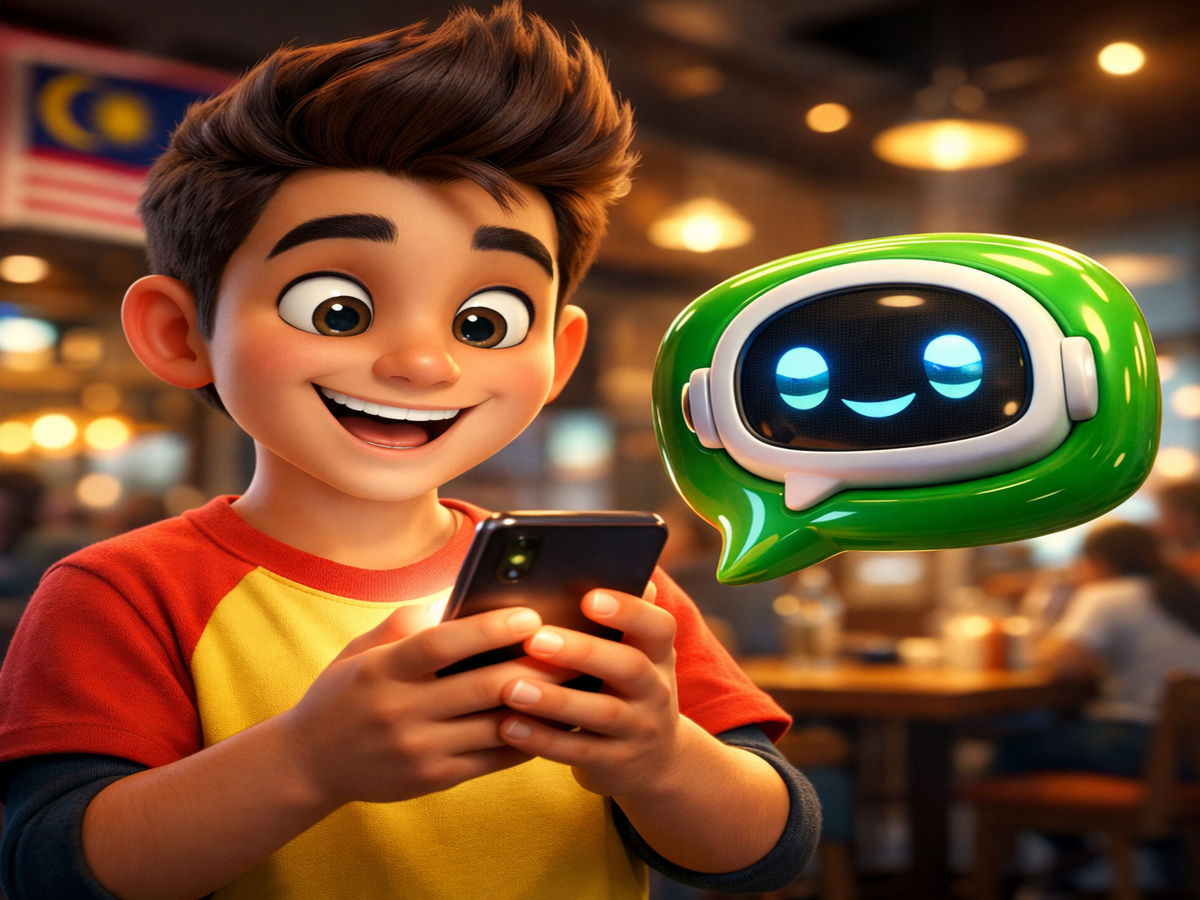
What an AI chatbot on WhatsApp Business actually handles, what it costs in Malaysia in 2026, when to hand over to a human, and a two-week launch checklist.
5 messages your WhatsApp AI chatbot should answer instantly
A 25-second summary of the practical first-response workflow.
Updated 22 September 2026 — pricing, WhatsApp API rules and handover practices reviewed for the current year.
In Malaysia, WhatsApp is not a marketing channel. It is the counter. Customers message the same way they walk into a shop: they ask the price, they ask if you are open, they ask if you can deliver to their area — and they expect an answer now. An AI chatbot on WhatsApp Business exists for one reason: to make sure nobody who messages you at 11pm is still waiting at 9am the next morning.
This guide covers what an AI chatbot on WhatsApp actually does, what it costs in Malaysia in 2026, how the handover to a human should work, and a launch checklist you can follow in a fortnight.
What an AI chatbot on WhatsApp really handles
Roughly 70–80% of incoming WhatsApp messages to a Malaysian SME are the same handful of questions. Those are what you automate first:
- Price and package questions — "how much", "got package or not", "monthly ada?"
- Availability — opening hours, stock, next available booking slot
- Location and delivery — where you are, whether you cover Seri Kembangan, Puchong, Cheras, Shah Alam, Klang
- Qualifying details — what the customer needs, budget range, timeline, so your team opens the chat already knowing the job
- Follow-up — nudging a quote that went quiet after three days without anyone remembering to do it
What it should not handle: negotiation, complaints, anything involving a refund, and anything where the customer has already said something emotional. Those go to a person immediately.
Why 2026 bots work when the 2019 ones failed
The old generation matched keywords. If your customer typed "brape harga ea" instead of "price", the bot broke and the customer left. Current models read intent, not spelling. They handle Manglish, Malay, Mandarin and the mix of all three in one sentence — which is how people genuinely type here.
The second difference is memory. A modern setup knows this is the same person who asked about a service last Tuesday, so it does not restart the conversation from zero. That single behaviour is what makes an automated chat feel like a competent staff member rather than a form.
WhatsApp Business app vs WhatsApp Business API
This is the decision most owners get wrong, so here it is plainly.
| Option | Cost | AI chatbot possible? | Best for |
|---|---|---|---|
| Staff personal WhatsApp | Free | No | Nothing — you lose the chat history when staff leave |
| WhatsApp Business app | Free | Only canned quick replies and away messages | Solo operators under ~20 chats a day |
| WhatsApp Business API + AI platform | From about RM149/month plus Meta conversation fees | Yes, full AI replies, handover, CRM logging | Any business where missed messages cost real money |
| Custom multi-system build | RM8,000–RM20,000 one-off | Yes, plus bookings, stock, invoicing | Clinics, workshops, multi-branch retail |
Meta charges separately per conversation on the API, and the rate depends on whether your business or the customer started the chat. Customer-initiated service conversations are the cheapest — which is another reason your website and ads should push people to message you first.
The handover rule that saves the customer
Every good WhatsApp bot has an exit. Set it to pass the chat to a human the moment any of these happen:
- The customer asks for a discount or mentions a competitor's price
- The same question is asked twice — meaning the answer did not land
- The message contains frustration, a complaint, or the word "refund"
- The customer types "call me", "human", "boss", or "sales"
- The conversation reaches the point of taking payment
Announce the handover: "Let me get my colleague on this, one moment." Customers forgive a bot that knows its limits. They do not forgive one that loops.
What it costs a Malaysian SME in 2026
| Setup | One-off | Monthly | What you get |
|---|---|---|---|
| FAQ + lead capture bot | From RM5,000 | RM149–RM399 | Answers the common questions, collects name, need and contact, logs to CRM |
| Booking or appointment bot | RM8,000–RM15,000 | RM399–RM899 | Live slot checking, confirmations, reminders, reschedules |
| Multi-system agent | RM18,000–RM30,000+ | From RM1,200 | Connected to stock, invoicing, payments and multiple branches |
Judge the cost against one number: what one lost customer is worth to you. If a job is worth RM3,000 and you miss two enquiries a month because nobody replied after hours, the maths is not close.
Serving the Klang Valley round the clock
Your office in Seri Kembangan may close at 6pm, but messages from Puchong, Cyberjaya, Kajang, Cheras and Shah Alam keep coming until midnight. Evening and weekend messages are often the most valuable ones — that is when people research services they intend to buy. An always-on first reply, in the customer's own language, is the cheapest competitive advantage available to a Malaysian SME right now.
Two-week launch checklist
- Week 1, day 1–2: Export the last 200 WhatsApp conversations and list the questions by frequency. This is your script — do not invent it.
- Day 3: Write your real answers, with prices or price ranges. A bot that cannot state a price is useless.
- Day 4: Decide your handover triggers and who receives them during and after office hours.
- Day 5: Apply for WhatsApp Business API access and verify your business with Meta. Start this early; verification is the usual delay.
- Week 2, day 1–2: Build and connect the bot to your CRM so every chat becomes a record, not a chat log.
- Day 3: Test in English, Bahasa Malaysia and Mandarin, including misspelled and mixed-language messages.
- Day 4: Add the WhatsApp button to every page of your website with the message pre-filled, and add tracking so you know which page produced the chat.
- Day 5: Go live, then review transcripts weekly for the first month and fix the answers people did not accept.
Mistakes we see most often
- Automating the whole sale instead of the first reply and qualification
- No price anywhere in the bot, so every chat still needs a human
- English-only replies in a market where Malay and Mandarin messages are routine
- No tracking, so you cannot tell whether the chats came from Google, Meta ads or your ad spend at all
- Never reading the transcripts after launch — a bot that is not reviewed slowly stops being accurate
How to measure whether the bot is working
Track four numbers monthly, nothing more. First-reply time — should fall to seconds. Conversations handled without a human — a healthy range is 50–70%; above 90% usually means the handover rules are too tight and customers are being trapped. Qualified enquiries per month compared with the three months before launch. Closed jobs that started as a WhatsApp chat, which is the only number that pays for the system.
If handled-without-human is high but closed jobs have not moved, the bot is answering questions but not moving people to a decision. Usually the fix is a clearer next step in each reply: an offer to check a slot, send a quote, or connect a person by name.
Keeping it compliant and trustworthy
Tell people they are talking to an assistant in the first message — it costs nothing and prevents complaints later. Only message customers who started the conversation or gave you permission; unsolicited broadcast blasts are how numbers get restricted by Meta. Store chats in your own CRM so records survive staff changes, keep personal data to what you actually need under Malaysia's PDPA, and give customers a simple way to ask for a human or to stop receiving follow-ups. Trust is the thing you are buying with automation; a bot that behaves badly spends it faster than a slow reply ever did.
Where to go next
If you want to see the plans and what is included at each level, read our AI chatbot service page. If you want the chats to land in a system your team can actually work from, look at the WhatsApp CRM. For a broader automation scope across quotes, follow-ups and internal workflows, see AI agents, and if your website itself is the weak point, start with web design.
Ready to stop losing after-hours enquiries? WhatsApp us and we will map your top 20 customer questions into a working bot — tell us your industry and we will show you what it would reply.
Planning this for your own business? Our Seri Kembangan website design team page walks through scope, timeline and pricing.
Want replies to customers even at 2am?
An AI chatbot trained on your own business answers WhatsApp and website enquiries instantly, in three languages.
Or estimate your budget first with our free website cost calculator →Related articles
- AI AutomationWeb Design Puchong: How WhatsApp Automation and CRM Integration Turn Website Visitors into Loyal Customers
- AI AutomationWeb Design Malaysia: How AI Agents Automatically Qualify Leads Before Your Sales Team Wakes Up
- AI AutomationWebsite Designer Malaysia: SMEs Saving 20+ Hours Weekly Through Smart Automation