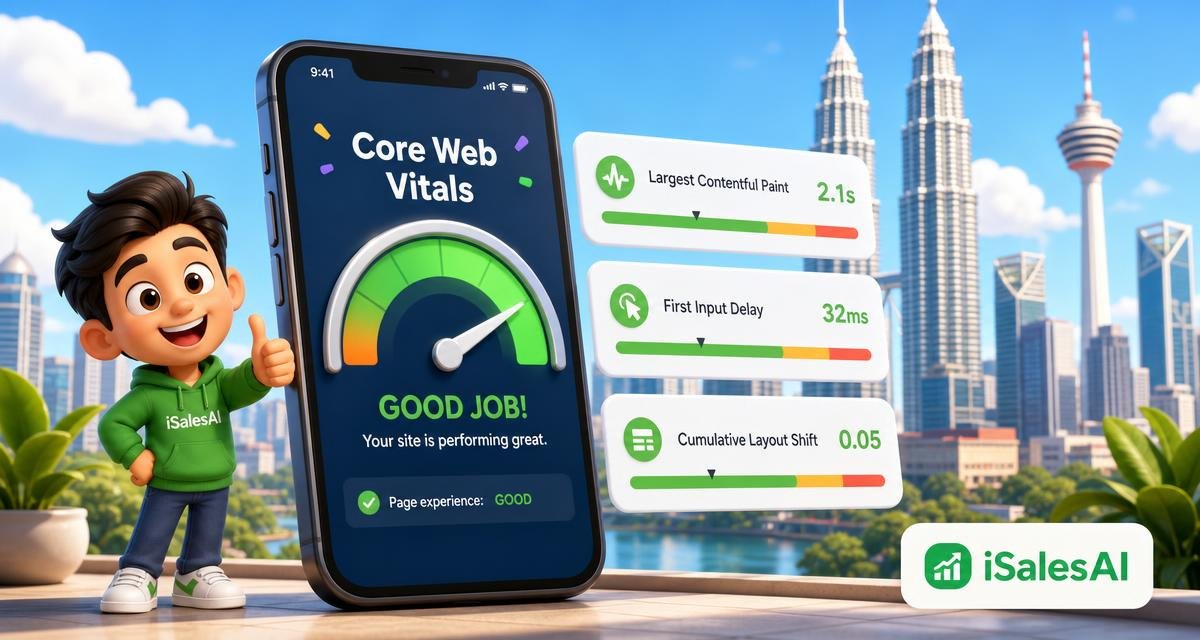
LCP, INP and CLS decide how your site ranks and converts on Malaysian mobile networks. Here are the exact numbers to aim for, how to measure them properly, and the fixes that move the needle.
Speed Is a Revenue Metric, Not a Vanity Score
Most Malaysian business sites are judged on a desktop connection in an office. Real customers open them on a phone, on mobile data, somewhere between a car park and a lift lobby. That gap is why a site that “feels fast” still loses enquiries.
Google measures the phone experience through three Core Web Vitals, and it uses field data from real visitors — not a lab test — when deciding how your pages perform.
The Three Numbers That Matter
| Metric | What it measures | Target (mobile) |
|---|---|---|
| LCP | Time until the main image or headline is visible | Under 2.5s |
| INP | Delay between a tap and a visible response | Under 200ms |
| CLS | How much the layout jumps while loading | Under 0.1 |
These are the pass marks, not the goal. On Malaysian 4G, sites that win competitive local searches typically land closer to LCP 1.8s and INP 120ms, because they were built without the plugin stack that slows everyone else down.
How to Measure It Honestly
- Use field data first. The Core Web Vitals report in Google Search Console shows what real visitors experienced over the last 28 days. A lab score of 95 means little if the field report is failing.
- Throttle to mobile. Test with a simulated 4G connection and a mid-range Android profile, not your own fibre line and flagship phone.
- Test the pages that earn money. Home, the top service page, and one blog article — templates differ, and the service page is usually the slowest.
- Re-test after every content update. One uncompressed hero image uploaded by a staff member can undo a month of optimisation.
The Fixes That Actually Move the Numbers
Image discipline beats everything else
Images are the single biggest cause of failing LCP on Malaysian SME sites. Serve WebP or AVIF, size them to the container rather than uploading 4000px originals, set explicit width and height to stop layout shift, and lazy-load everything below the fold while leaving the hero eager.
Cut third-party scripts to the ones you use
Chat widgets, three analytics tags, a heatmap tool and two ad pixels each add main-thread work that pushes INP over the limit. Audit the list, delete what nobody reads, and load the survivors after interaction rather than in the head.
Move off plugin-stacked page builders
Legacy builders ship large CSS and JavaScript bundles for features a page never renders. Component-based React and Framer builds send only what the page needs, which is why they clear the thresholds without constant tuning.
Fix fonts and embeds
Self-host or preload web fonts with a swap fallback, reserve space for embedded maps and videos, and never inject banners above content after load.
What Passing Actually Buys You
Core Web Vitals will not outrank genuinely better content on their own. What they do is remove a handicap: when two Malaysian businesses have similar authority for the same local search, the faster, more stable page wins the click and keeps the visitor long enough to convert.
If your current site fails the field report and no amount of caching plugins fixes it, the architecture is usually the problem rather than the settings. Our web design Malaysia team rebuilds on a component-based stack with performance budgets baked in, and can pair it with SEO growth work so the speed gains translate into rankings.
Planning this for your own business? Our web design Kuala Lumpur page walks through scope, timeline and pricing. If you are based in Cheras we scope the build around your area, your languages and the leads you actually want.
Want a website that actually brings in leads?
We build trilingual (EN/BM/中文) business websites in 2–4 weeks, with clear scope and pricing from the start.
Or estimate your budget first with our free website cost calculator →Related articles
- Web DesignWebsite Designer Malaysia: Why Growing E-Commerce Brands Are Ditching Shopify for Custom React Storefronts
- Web DesignWebsite Design Trends in June 2026: 10 Features Every Malaysian Business Website Must Have
- Web DesignCustom React Web Design vs. Wix/WordPress: Which is Better for Malaysian SEO?