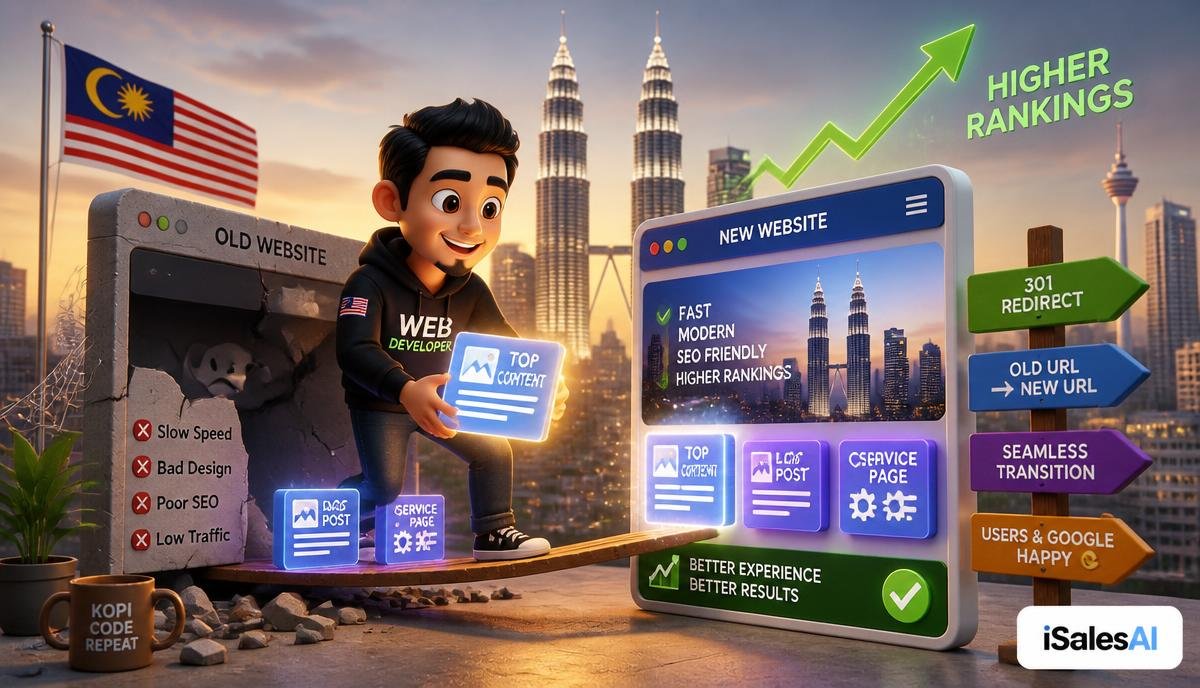
Most traffic collapses after a redesign are self-inflicted. Here is the migration sequence Malaysian businesses should follow before, during and after launch to keep every ranking they have.
The Redesign That Cost More Than It Saved
The pattern repeats every month. A Malaysian SME launches a beautiful new website, and within three weeks the enquiries dry up. The design is better. The traffic is gone. Nothing was hacked and Google did not penalise anything — the new site simply threw away the signals the old one had accumulated.
Every ranking you hold is attached to a URL. Change the URLs without telling Google where they went, remove the text that earned the ranking, or slow the pages down, and you are effectively launching a brand-new site with none of the history.
Before You Touch the Design: Take Inventory
- Export every URL that exists today, from Search Console, your sitemap and a crawl. Not the pages you remember — all of them.
- Rank them by clicks and impressions over the last twelve months. Usually a handful of pages carry most of the traffic, and they are rarely the homepage.
- Record the current title, description and word count of each of those pages, so you can prove parity later.
- List every page with backlinks. An old blog post with a link from a news site or an association directory is an asset; deleting it is throwing money away.
This inventory is the entire safety net. Skipping it is why most migrations fail.
Map Old URL to New URL, One by One
Build a spreadsheet with two columns: the old URL and its closest equivalent on the new site. Every old URL needs a destination. Rules to hold yourself to:
- Redirect to the closest matching page, never blanket-redirect everything to the homepage — Google treats that as a soft 404 and drops the ranking.
- Use permanent 301 redirects, not 302 or JavaScript redirects.
- Avoid redirect chains. Old A should point straight to new C, not to B and then C.
- Decide trailing slash and www versus non-www once, and make everything else redirect to that single canonical form.
Keep the Content That Earned the Ranking
Designers shorten copy. Search engines read it. If a service page ranking for a competitive Malaysian keyword had 1,200 words covering pricing, process and FAQs, and the redesign reduces it to a hero image and three bullet points, the ranking goes with the words. Redesign the presentation, keep the substance — then improve it. The same applies to headings, image alt text, internal links and structured data.
Test on Staging, Not in Production
Before launch, crawl the staging site and check: every page has a unique title and description, canonical tags point to the live domain rather than the staging URL, the staging site is blocked from indexing, no page returns a 404 or a redirect chain, and Core Web Vitals on a mid-range phone over Malaysian mobile data are genuinely good — not just fast on your office fibre.
Launch Day Sequence
- Remove the staging noindex before going live — the single most common launch mistake in this country and elsewhere.
- Deploy redirects at the same moment as the new site, not the day after.
- Submit the new sitemap in Search Console and request indexing for your top ten pages.
- Verify analytics and conversion tracking still fire, especially WhatsApp click tracking and form submissions.
The First Ninety Days
Expect a modest wobble in the first two weeks; Google needs to recrawl and re-consolidate. What you are watching for is the difference between a wobble and a slide. Check the Search Console coverage report weekly for new 404s, compare clicks per page against your pre-launch inventory, and fix anything that dropped more than a little. Keep the redirects in place permanently — deleting them a year later resurrects the whole problem.
When a Redesign Should Increase Traffic
Done properly, a migration is an opportunity: faster pages, cleaner internal linking, proper localisation for Bahasa Malaysia and Chinese audiences, and service or location pages that never existed on the old site. The rankings you protect are the floor, not the ceiling.
If you are planning a rebuild, our web design team runs this migration checklist as standard, and our SEO services cover the post-launch monitoring window.
Planning this for your own business? Our Seri Kembangan website design team page walks through scope, timeline and pricing.
Want to rank for what your customers search?
We do technical SEO, local pages and content that gets Malaysian SMEs onto page one — not just traffic reports.
Or estimate your budget first with our free website cost calculator →